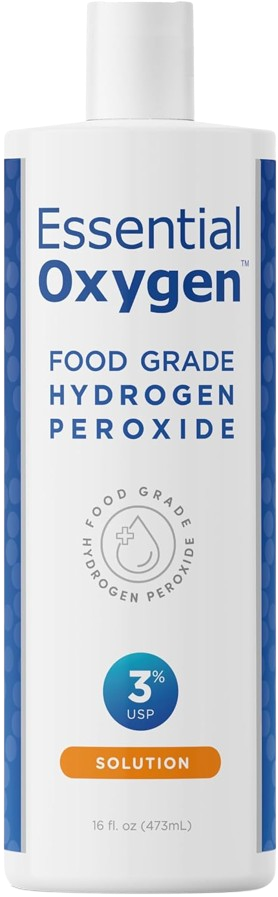
Essential Oxygen Food Grade Hydrogen Peroxide is a multipurpose hydrogen peroxide solution marketed for household cleaning, stain removal and selected personal-care applications. The product is available in several sizes, including spray bottles and larger containers. Unlike some conventional hydrogen peroxide products, Essential Oxygen states that its formula contains no added stabilizers. However, the term “food grade” should not be interpreted as meaning that the product is safe to drink or suitable for every food-related or health-related use.
The manufacturer’s product page identifies the concentration as 3% hydrogen peroxide and lists only two ingredients: deionized water and hydrogen peroxide. Hydrogen peroxide is an oxidizing agent that breaks down into water and oxygen. Its chemical activity makes it useful for certain cleaning and stain-removal applications, but it can also irritate or damage living tissue. The absence of additional stabilizers makes the ingredient list simple, but it does not eliminate the risks associated with hydrogen peroxide itself.
For household use, hydrogen peroxide can help remove some organic stains and clean appropriate hard surfaces. Essential Oxygen markets its product for uses including countertops, kitchen utensils, cutting boards, bathroom surfaces and laundry. The spray format is convenient for applying the solution to selected areas. Nevertheless, users should check the manufacturer’s instructions for each intended application, particularly when cleaning food-contact surfaces, electronics or materials that could be damaged by oxidation. Do not assume that every surface is disinfected simply because it has been sprayed; effective disinfection depends on the product’s approved directions and contact time.
Ingredient transparency is one of this product’s strongest features. The listed formula is straightforward, with no fragrance or additional cleaning surfactants shown on the cited product page. This may appeal to consumers who prefer products with fewer ingredients. However, a short ingredient list is not the same as proof of overall safety, and hydrogen peroxide can still cause eye irritation, skin discomfort and injury if used incorrectly.
The most important consideration is the distinction between household cleaning and internal use. Essential Oxygen advertises a range of suggested applications, including oral and ear care, but independent toxicology guidance warns against swallowing hydrogen peroxide and notes that it can damage tissues. The product should not be drunk, nebulized, injected, or used in the ears, throat or other body areas unless a qualified healthcare professional specifically confirms that the exact product and use are appropriate. Hydrogen peroxide is also no longer recommended for routine cleaning of minor wounds because it can damage cells involved in healing.
Food-related claims also deserve care. A product described as food grade is not automatically a food ingredient, and it should not be consumed or applied to food unless the specific label explicitly authorizes that use and provides clear directions. For ordinary fruit and vegetable preparation, washing under clean running water is a straightforward choice; do not improvise a peroxide dilution or soak based on online advice.
For safer household handling, keep the solution in its original, clearly labeled container, store it away from children and pets, and avoid eye contact or inhaling spray mist. Follow the label’s storage and disposal directions. If it gets into the eyes, rinse thoroughly with water; if swallowed, seek prompt advice from a poison-control service or medical professional.
Essential Oxygen Food Grade Hydrogen Peroxide offers a simple, fragrance-free formula that may be useful for selected household cleaning tasks. Its main strengths are ingredient transparency and versatility, while its limitations involve tissue irritation, the potential for misuse and misleading assumptions about the phrase “food grade.”
Pros
- Simple two-ingredient formula
- No added fragrance listed on the cited product page
- 3% hydrogen peroxide concentration clearly stated
- Available in spray and larger bottle formats
- Useful for selected household cleaning and stain-removal tasks
- Manufacturer provides product and ingredient information
Cons
- Can irritate or damage eyes and living tissue
- “Food grade” wording may create a misleading impression that it is edible
- Not suitable for drinking or improvised internal-health treatments
- Spray application may expose users to mist
- Requires careful storage and use according to label directions
- Not every advertised use is supported by independent medical evidence
Safety Scores
Ingredient List
Deionized Water, Hydrogen Peroxide (3%)