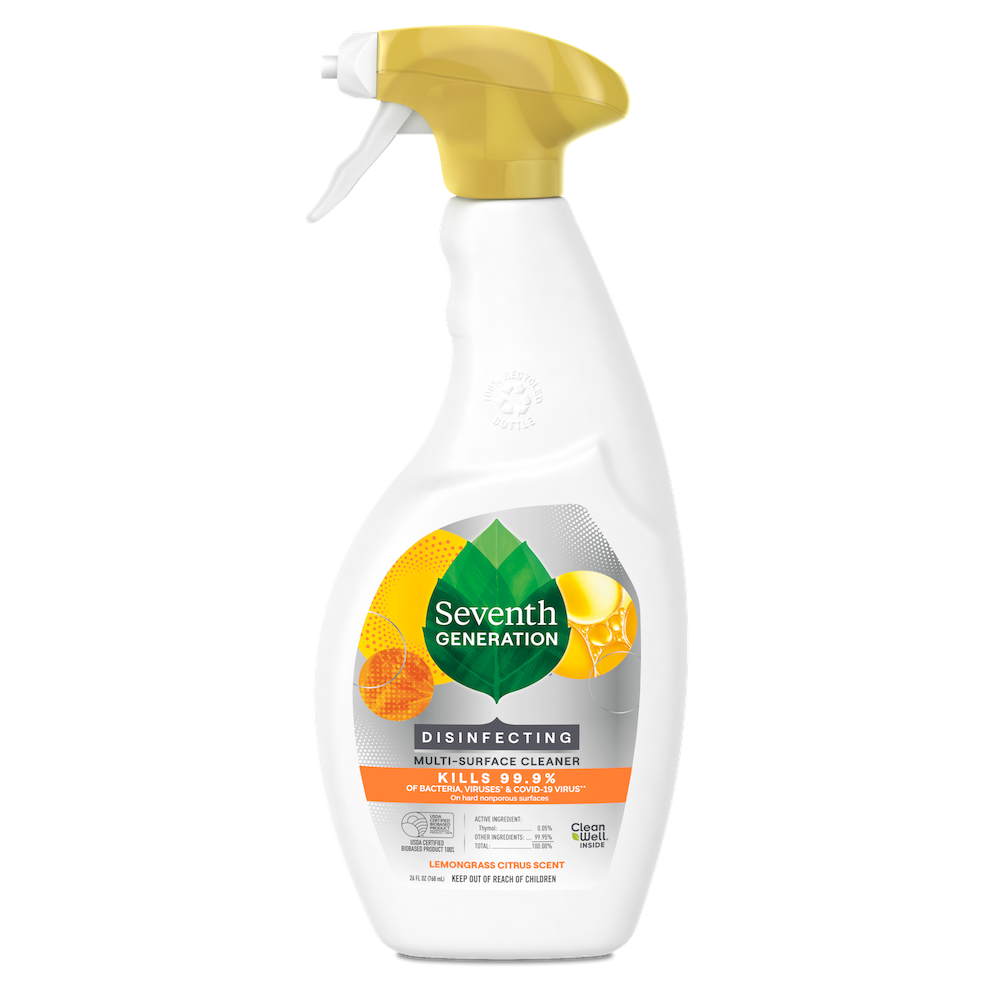
Seventh Generation Disinfecting Spray
Summary
Seventh Generation Disinfecting Spray is a household disinfectant designed for cleaning and disinfecting hard, nonporous surfaces. It is intended for areas where bacteria, viruses, and unpleasant odors may be a concern, including countertops, bathroom surfaces, children’s toys, highchairs, changing tables, pet cages, and pet bowls. The current Eucalyptus, Spearmint & Thyme version uses thymol as its antimicrobial active ingredient and is packaged as an aerosol powered by compressed air.
The main active ingredient is thymol, which Seventh Generation identifies as coming from thyme oil. The company’s current product information lists thymol along with water, sodium lauryl sulfate, citric acid, sodium citrate, copper sulfate pentahydrate, and a mixture of essential oils used for fragrance. The formula also contains compressed air as the propellant. Seventh Generation states that the product is gluten-free and contains no phosphates.
One of the product’s main selling points is its disinfecting performance. According to Seventh Generation, the spray kills 99.9% of bacteria and viruses on hard, nonporous surfaces, including organisms such as Staphylococcus aureus, E. coli, Salmonella enterica, influenza A, rhinovirus, norovirus, and SARS-CoV-2. These are manufacturer claims made for the product under its labeled conditions, so users should follow the instructions on the specific container rather than assuming the spray disinfects every type of surface or microorganism.
The ingredient profile is worth looking at closely from a SafetyScore perspective. Thymol provides the antimicrobial function, while sodium lauryl sulfate helps with cleaning. Citric acid and sodium citrate support the formula, and essential oils provide much of the characteristic scent. The current version lists eucalyptus, mint, spearmint, rosemary, and orange peel oils among its fragrance ingredients. The brand also identifies d-limonene as a fragrance allergen.
Because this is a disinfectant rather than an ordinary surface cleaner, responsible use is important. Seventh Generation specifically instructs users to apply the product to hard, nonporous surfaces and follow the required contact time. The product should not be sprayed directly into the eyes, and household cleaning products should always be kept away from children. An older Seventh Generation safety data sheet for the disinfecting cleaner category reported minimal eye irritation and none-to-slight dermal irritation based on the ingredients, while also noting that exposure can occur through the eyes, skin, ingestion, or inhalation.
Another consideration is fragrance sensitivity. Although the product uses essential oils rather than simply relying on a conventional synthetic fragrance blend, “plant-based” does not automatically mean irritation-free. Essential oils and fragrance components can still be problematic for some sensitive individuals. This is particularly relevant when the spray is used frequently or in poorly ventilated areas.
Overall, Seventh Generation Disinfecting Spray is a purpose-built household disinfectant with a clearly identified antimicrobial ingredient and a disclosed ingredient list. Its strongest advantage is that it combines cleaning, deodorizing, and disinfecting functions in a convenient spray format. The main considerations are proper surface use, following the labeled contact time, avoiding eye exposure, and being aware of fragrance and essential-oil ingredients. For SafetyScore.io, the exact product version should be identified because Seventh Generation sells multiple disinfecting pro
Pros
- Uses thymol 0.05% as the antimicrobial active ingredient
- Effective against a broad range of specified microorganisms
- No bleach
- Uses compressed air as a non-flammable propellant
- No phosphates
- Ingredient disclosure is relatively detailed
- Suitable for hard, nonporous surfaces
- Manufacturer states it does not leave harmful residue when used as directed
Cons
- Contains sodium lauryl sulfate
- Contains essential oils/fragrance
- Fragrance allergens can be present depending on the scent
- Contains copper sulfate pentahydrate at less than 0.1%
- May cause eye or skin irritation if improperly used
- Not intended for direct application to skin
- Aerosol container must be kept away from excessive heat and should not be punctured
Safety Scores
Ingredient List
Aqua/Water, Citric Acid, Compressed Air (Propellant), Copper Sulfate Pentahydrate (Bluestone), Essential Oils/Fragrance, Sodium Citrate, Sodium Lauryl Sulfate, Thymol (0.05%)