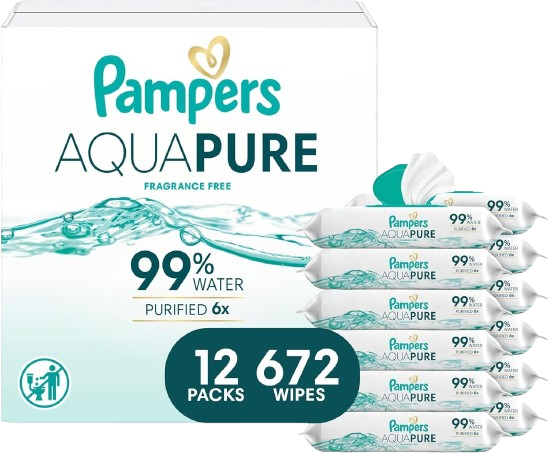
Pampers Aqua Pure Baby Wipes are designed as a simple, water-based option for cleaning babies’ skin during diaper changes. Pampers describes the wipes as containing 99% purified water, with a small amount of additional ingredients used for cleansing, pH control and preservation. The product is marketed as hypoallergenic, fragrance-free and suitable for newborns and sensitive skin. Pampers also states that Aqua Pure wipes are free from alcohol, dyes, parabens, sulfates, phenoxyethanol, methylisothiazolinone and natural rubber latex.
The formula is particularly short compared with many conventional baby wipes. The current ingredient list includes water, citric acid, sodium citrate, sodium benzoate, PEG-40 hydrogenated castor oil, sorbitan caprylate and disodium EDTA. The same seven-ingredient formula is currently listed by CVS and French retailers, although ingredient lists can change by market or over time, so the packaging remains the best final reference.
Water is the main ingredient and makes up approximately 99% of the lotion. Pampers uses a multi-step purification process for the water, including reverse osmosis, UV exposure and ozonization. This gives Aqua Pure a particularly minimal base compared with wipes that contain fragrances, botanical extracts or larger conditioning systems.
The formula also uses citric acid and sodium citrate as a pH-buffering system. Maintaining an appropriately acidic skin environment is relevant for infant skin because the natural skin surface is mildly acidic. Pampers says its wipes are designed to help maintain the natural pH balance of the baby’s skin. The company currently describes its wipes generally as being formulated around a skin-friendly pH range.
PEG-40 hydrogenated castor oil functions primarily as an emulsifier and helps remove oily residue during cleaning. While the ingredient name may sound unfamiliar, its presence in this formula is functional rather than an indication that the wipe contains a harsh detergent. Pampers specifically describes it as a gentle emulsifier used to help remove soil from the baby’s bottom.
The preservation system is another important part of the assessment. Sodium benzoate, sorbitan caprylate and disodium EDTA help protect the water-based lotion from microbial contamination and deterioration after opening. This is worth mentioning because a wipe containing mostly water still requires preservation to remain microbiologically stable. Pampers explains that preservatives are used in very small quantities for this purpose.
From a skin-tolerance perspective, Aqua Pure has several advantages. It is fragrance-free, alcohol-free and dye-free, with a relatively short ingredient list. Pampers also states that the wipes are hypoallergenic and have undergone dermatological testing, while the brand’s safety materials describe independent dermatological involvement through the Skin Health Alliance. These are positive indicators, although “hypoallergenic” should never be interpreted as meaning that an individual baby cannot react to the product.
The wipe material is also worth considering. Pampers describes Aqua Pure as using cotton, regenerated cellulose and polyester in its U.S. materials information, while some European versions are described as using plant-derived fibers. This means the exact wipe substrate may vary by market, even when the lotion formula is similar.
Overall, Pampers Aqua Pure is one of the simpler mainstream baby-wipe formulas. Its strongest points are the high purified-water content, absence of fragrance and alcohol, short ingredient list and pH-buffering system. The main deductions come from the need for emulsifiers and preservatives and from the possibility of individual sensitivity to any ingredient.
For SafetyScore.io, this is an informational ingredient and formula assessment, not a medical safety guarantee or regulatory certification.
Pros
- 99% purified-water lotion
- Fragrance-free
- Alcohol-free
- Dye-free
- Short, relatively simple formula
- pH-buffering system
- Hypoallergenic and dermatologically tested according to Pampers
- Suitable from birth according to Pampers
Cons
- Contains preservatives
- Contains PEG-40 hydrogenated castor oil
- Individual skin reactions are still possible
- Formula and wipe material can vary between markets
- Not flushable
Safety Scores
Ingredient List
Citric Acid, Disodium EDTA, PEG-40 Hydrogenated Castor Oil, Sodium Benzoate, Sodium Citrate, Sorbitan Caprylate, Water