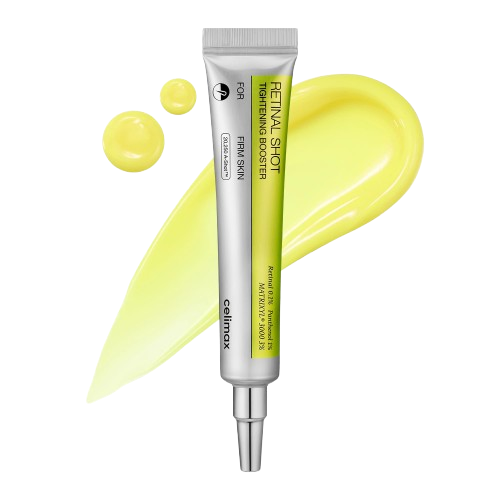
celimax The Vita A Retinal Shot Tightening Booster
Summary
celimax The Vita A Retinal Shot Tightening Booster is a targeted vitamin A skincare treatment designed for people concerned about wrinkles, enlarged pores, uneven texture and loss of firmness. The formula contains 0.1% retinal, along with niacinamide, panthenol, vitamin E, adenosine and Matrixyl peptides. According to celimax, the product uses its A-Shot technology to help deliver the active ingredients into the skin and is intended to be applied in small amounts to areas of concern.
The key ingredient is retinal (retinaldehyde). Retinal is a vitamin A derivative that sits between retinol and retinoic acid in the skin’s conversion pathway. It has been studied for its effects on skin renewal and signs of photoaging. A clinical review of topical retinoids describes retinaldehyde as having a favorable activity-to-tolerance profile, although the strength of evidence varies between different formulations and concentrations.
The product contains 0.1% retinal, which is a meaningful concentration for a cosmetic retinal product. Published research has investigated 0.1% retinaldehyde formulations for photoaged skin, with results supporting improvements in certain measures of wrinkles and skin texture while maintaining a generally good safety profile. However, those clinical findings should not automatically be interpreted as proof that this specific celimax formulation will produce identical results, because formulation and study conditions differ.
One of the more useful aspects of the formula is that retinal is combined with several skin-conditioning ingredients. Niacinamide is included relatively high in the ingredient list, while panthenol provides a moisturizing and soothing component. The formula also contains glycerin, vitamin E (tocopherol), sodium lactate and several emollients that contribute to skin conditioning. These ingredients can be useful when introducing an active vitamin A product into a routine.
The formula also contains Palmitoyl Tripeptide-1 and Palmitoyl Tetrapeptide-7, commonly associated with Matrixyl-type peptide formulations. celimax markets the product as containing 3% Matrixyl, although the complete ingredient list does not separately disclose the concentration of each peptide. For that reason, it is more appropriate to describe the peptides as supporting ingredients rather than assuming a specific individual peptide concentration.
The main consideration from a safety perspective is still retinal irritation. Even though published studies generally report good tolerance, vitamin A derivatives can cause dryness, redness, peeling or temporary sensitivity, particularly when someone is new to them. celimax specifically recommends using the product every other night for the first two weeks and reducing the amount or frequency if irritation develops.
Retinaldehyde has a relatively well-documented tolerance profile. Older clinical research involving topical retinaldehyde found that 0.1% and 0.05% preparations were generally well tolerated with prolonged use. Another study comparing topical retinoids found substantially more irritation with retinoic acid than with retinaldehyde. These studies provide useful evidence about the ingredient itself, but they do not eliminate the possibility of individual reactions.
For someone starting this product, gradual introduction is sensible. Using it at night and applying moisturizer can help improve comfort. celimax also recommends sunscreen the following morning. People with an already damaged or irritated skin barrier should be particularly cautious with vitamin A products.
Overall, celimax The Vita A Retinal Shot Tightening Booster has a relatively focused formula built around 0.1% retinal, supported by niacinamide, panthenol, antioxidants and peptides. Its principal strength is the use of a well-studied retinaldehyde concentration, while its main limitation is the potential for retinoid-related irritation. The available evidence supports retinal as a legitimate cosmetic active, but individual tolerance and results can vary considerably.
For SafetyScore.io, the product can reasonably be evaluated as a retinal-based active treatment rather than a basic moisturizer. Its ingredient profile is generally straightforward, but users should introduce it gradually and follow the manufacturer’s directions, particularly if they have sensitive or easily irritated skin.
Pros
- Contains 0.1% retinal, a vitamin A derivative used for improving the appearance of wrinkles and uneven texture.
- Contains niacinamide and 1% panthenol, which provide skin-conditioning and barrier-supporting benefits.
- Includes Palmitoyl Tripeptide-1 and Palmitoyl Tetrapeptide-7.
- Contains tocopherol (vitamin E) and ascorbic acid.
- No added fragrance appears in the published ingredient list.
- Designed to target wrinkles, enlarged pores and uneven texture.
- Manufacturer recommends gradual introduction, which is useful for reducing irritation when starting a retinal product.
Cons
- Retinal can cause irritation, especially for people who are new to vitamin A products.
- Dryness, redness, peeling or tingling can occur.
- The product contains hydrolyzed sponge, associated with the product's A-Shot technology, which may contribute to a tingling sensation.
- Not the best choice for skin that is already irritated or has a compromised barrier.
- Requires consistent daytime sunscreen use according to the manufacturer.
- Individual tolerance can vary, so a patch test is sensible before regular use.
Safety Scores
Ingredient List
2-Hexanediol, Adenosine, Arginine, Ascorbic Acid, Butylene Glycol, Caprylic/Capric Triglyceride, Carbomer, Cetearyl Alcohol, Cetearyl Glucoside, Cetearyl Olivate, Diisostearyl Malate, Dimethicone/Vinyl Dimethicone Crosspolymer, Disodium EDTA, Ethylhexylglycerin, Glucose, Glycerin, Hydrolyzed Sponge, Hydroxyethyl Acrylate/Sodium Acryloyldimethyl Taurate Copolymer, Lecithin, Niacinamide, Palmitoyl Tetrapeptide-7, Palmitoyl Tripeptide-1, Panthenol, Polypropylsilsesquioxane, Polysorbate 20, Retinal, Sodium Lactate, Sorbitan Isostearate, Sorbitan Olivate, Tocopherol, Water, Xanthan Gum