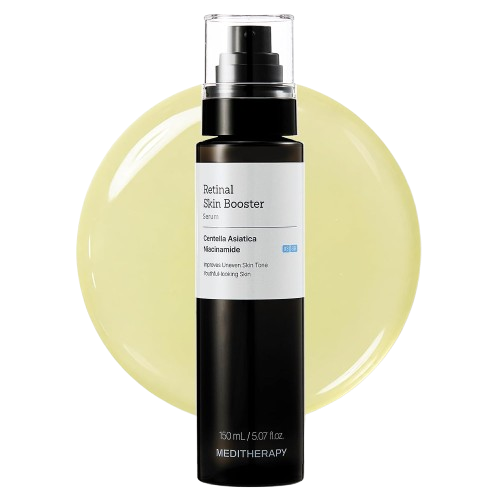
MEDITHERAPY Retinal Skin Booster
Summary
MEDITHERAPY Retinal Skin Booster is a Korean skincare serum designed around retinal, a vitamin A derivative commonly used in anti-aging skincare. The product is marketed toward concerns such as fine lines, uneven skin tone, loss of firmness and overall skin texture. MEDITHERAPY lists 100 ppm of retinal, equivalent to approximately 0.01% retinal, in the formula. The serum also combines retinal with niacinamide, hyaluronic acid, ceramide NP, panthenol, beta-glucan, centella asiatica and vitamin E.
Retinal, also known as retinaldehyde, is one of the better-studied cosmetic retinoids. It is a precursor to retinoic acid and has been investigated for improving signs of photoaging. Clinical research has found that topical retinaldehyde can improve aspects of skin texture and photoaging while generally being well tolerated. However, evidence from studies of retinaldehyde as an ingredient should not automatically be treated as proof that every commercial retinal product will deliver identical results. Formulation, concentration and application frequency all matter.
The concentration in this MEDITHERAPY formula is relatively low compared with the 0.05% and 0.1% retinaldehyde concentrations investigated in some clinical trials. One randomized controlled study involving 40 women found that both 0.05% and 0.1% retinaldehyde creams improved skin texture and hydration after three months, with both formulations reported as well tolerated. The 0.1% formulation also produced a significant improvement in the study’s melanin index. These findings provide useful context for retinaldehyde, but they should not be directly transferred to MEDITHERAPY’s much lower 0.01% concentration.
One of the strengths of the MEDITHERAPY formula is that retinal is not used alone. Niacinamide appears relatively high in the ingredient list and is commonly used to support the skin barrier and improve the appearance of uneven tone. The formula also contains glycerin and sodium hyaluronate for hydration, along with cholesterol and ceramide NP, which are useful components in barrier-focused skincare. Panthenol and beta-glucan add additional moisturizing and skin-conditioning ingredients.
The ingredient list also includes several botanical and antioxidant ingredients, including centella asiatica, green tea water, artichoke leaf extract, fig extract, carrot extract and Polygonum cuspidatum root extract. These ingredients may contribute antioxidant or skin-conditioning properties, although the presence of an ingredient in a cosmetic formula does not necessarily mean that it will produce a clinically meaningful effect at the final concentration used.
Another point worth considering is the product’s liposomal delivery claim. MEDITHERAPY states that its retinal is contained in ultra-small liposome particles and claims enhanced absorption compared with standard retinol. These are manufacturer claims rather than independent clinical conclusions. For a SafetyScore assessment, it is more appropriate to evaluate the disclosed ingredients and concentration rather than assume that a marketing claim establishes superior efficacy.
From a safety perspective, the relatively low disclosed retinal concentration may make this product less aggressive than stronger retinal treatments. Nevertheless, retinal is still a vitamin A derivative and can cause dryness, redness, peeling or irritation in some users. Published research indicates that retinaldehyde generally has a favorable tolerance profile, but individual skin sensitivity remains important.
The formula is also notable for containing ceramide NP, cholesterol, panthenol and beta-glucan, which can be useful in a routine where maintaining skin comfort is important. However, the long ingredient list includes numerous botanical extracts, so people with known sensitivities to particular plant-derived ingredients should review the complete ingredient list carefully.
Overall, MEDITHERAPY Retinal Skin Booster is a relatively gentle-looking retinal serum built around a 0.01% disclosed retinal concentration, supported by hydrating, barrier-supporting and antioxidant ingredients. The available scientific evidence supports retinaldehyde as a legitimate cosmetic retinoid, although the strongest clinical evidence cited above involves higher concentrations than this product.
For SafetyScore.io, the main positive factors are the relatively low retinal concentration and the inclusion of niacinamide, ceramide NP, cholesterol, panthenol and other conditioning ingredients. The main considerations are potential retinoid irritation and the uncertainty around marketing claims concerning enhanced delivery. As with other vitamin A skincare products, gradual introduction and daytime sunscreen use are sensible parts of a routine.
Pros
- 0.01% retinal (100 ppm) provides a relatively gentle vitamin-A approach.
- Contains niacinamide for skin conditioning and barrier support.
- Ceramide NP and cholesterol help support the skin barrier.
- Contains panthenol and beta-glucan for moisturizing and soothing properties.
- Sodium hyaluronate and glycerin provide hydration.
- Includes Centella asiatica, madecassoside and asiaticoside.
- Contains antioxidant ingredients including tocopherol, green tea water and vitamin C derivatives.
- Fragrance-free according to available ingredient databases.
- The product has undergone an irritation test, according to retailer product information.
Cons
- Retinal can still cause dryness, redness, peeling or irritation, particularly when introduced too quickly.
- The formula contains a large number of botanical and active ingredients, which may increase the number of ingredients an especially sensitive user needs to consider.
- Contains macadamia seed oil, which may not suit everyone.
- The product's claims about enhanced liposomal absorption and clinical improvements are manufacturer claims and should not be treated as independent proof of performance.
- People who are sensitive to vitamin-A products should introduce it gradually.
Safety Scores
Ingredient List
1, 2-Hexanediol, Acetyl Hexapeptide-1, Adenosine, Aluminum/Magnesium Hydroxide Stearate, Ammonium Acryloyldimethyltaurate/VP Copolymer, Artichoke Leaf Extract, Ascorbyl Tetraisopalmitate, Asiatic Acid, Asiaticoside, Beta-Carotene, Beta-Glucan, Bifida Ferment Lysate, Butylene Glycol, Canola Oil, Caprylic/Capric Triglyceride, Caprylyl Glycol, Carbomer, Carrot Extract, Carrot Seed Oil, Centella Asiatica Extract, Centella Asiatica Leaf Extract, Centella Asiatica Root Extract, Ceramide NP, Cholesterol, Disodium EDTA, Ethylhexylglycerin, Fig Extract, Glycerin, Green Tea Water, Hydrogenated Lecithin, Hydroxypropyl Cyclodextrin, Kava Kava Leaf/Root/Stem Extract, Lactobionic Acid, Macadamia Seed Oil, Madecassic Acid, Madecassoside, Methylpropanediol, Myristyl Alcohol, Niacinamide, Oat Kernel Extract, Panthenol, PCA, Pentaerythrityl Tetra-Di-T-Butyl Hydroxyhydrocinnamate, Phenyltrimethicone, Polyglycerin-3, Polyglyceryl-10 Laurate, Polygonum Cuspidatum Root Extract, Polyquaternium-51, Potassium Cetyl Phosphate, Propanediol, Rapeseed Sterol, Retinal (100 ppm), Silverweed Extract, Sodium Acrylic Acid/MA Copolymer, Sodium Ascorbyl Phosphate, Sodium Hyaluronate, Sucrose Distearate, Sunflower Seed Oil, Tocopherol, Tocopheryl Acetate, Tromethamine, Water, Xanthan Gum, Yeast Ferment Filtrate